




How to Record a Podcast That Clips Well
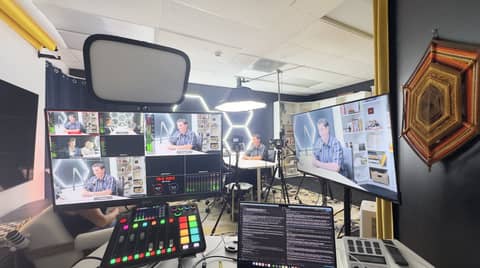
A one-hour recorded conversation usually contains three to five moments that work as standalone short-form clips, not the ten or twelve people plan for. Clips fail when they need the surrounding episode to make sense. The fix is recording for them: making self-contained points, restating the question before answering it, and giving each strong claim a clean run without crosstalk. At Kreate Vision Studio in Palatine, Illinois the three-camera setup and separate audio tracks are what make a clip cuttable at all, because a reaction shot and a clean single voice have to exist at recording time.
Clips are recorded, not extracted
The common assumption is that you record an episode and clips fall out of it. What happens is that somebody spends three hours scrubbing an hour of footage looking for moments that work alone, and finds four.
An hour of good conversation contains roughly three to five standalone moments. Not ten. Planning for ten and getting four feels like failure; planning for four and getting five feels like a good session. Same footage.
Why most clips fail
A clip has one job: make sense to somebody who has never heard of you, in about three seconds.
Most interesting moments in a conversation are interesting because of what came before. That is what makes them good in the episode and useless out of it. The build-up is the value, and the build-up is exactly what a clip cannot carry.
The test: play the clip to somebody who has not heard the episode. If they need context, it is an excerpt, not a clip.
Three habits that produce clips
These cost nothing during the recording and change the yield more than any editing decision.
Restate the question before answering it. Instead of “yeah, definitely,” say “does a small contractor need a podcast? no.” That sentence is a clip. The first one is not, and no editor can turn it into one.
Make points that finish. Land the claim, defend it briefly, stop. Conversations naturally trail into the next thought, and a trailing end means the clip has no out point.
Give the strong claims a clean run. When somebody is mid-way through the best thing they will say all session, everyone else stays quiet. This is the single hardest one, because a good point is precisely what makes other people want to jump in. The moment you talk over is usually the clip you lose.
What the room contributes
Two things make a clip cuttable at all, both have to exist at recording time, and both are standard here rather than an upgrade.
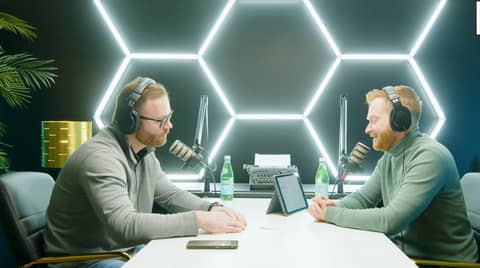
A second and third angle. A clip that stays on one locked frame for forty seconds is a clip people scroll past. Cutting between the speaker and a reaction is what holds attention, and the reaction shot cannot be added later. Three cameras is what makes that possible.
Separate audio tracks. A clip is usually one person talking. If the best line has somebody else’s agreement layered on top in a single mixed recording, it is gone. On separate tracks it is recoverable.
Framing for the vertical crop
The crop to vertical happens in post, but it works far better when the recording allowed for it.
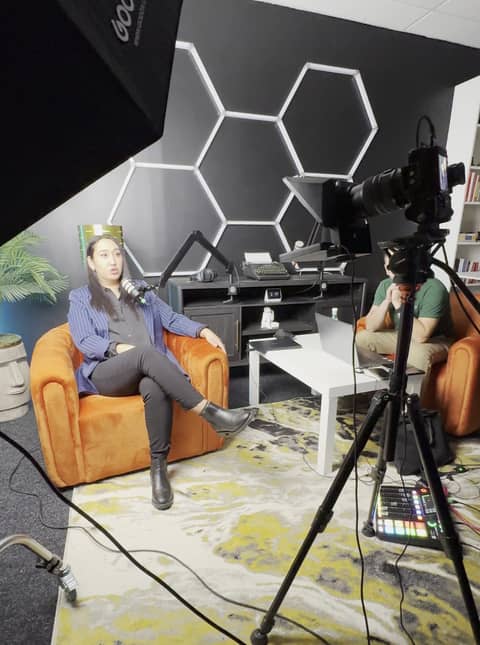
A tight two-shot crops badly: you end up with half of each face or a hard choice between them. A frame with a little air, and something legible happening behind the speaker, survives the crop with the composition still saying something.
Of the five sets, the visually loudest ones hold up best under a vertical crop, because the background is still doing work at phone size. A subtle set is a grey rectangle once you have cropped away everything either side of a head.
The arithmetic of that crop, and why a single wide shot cannot give you a close-up, is in why a video podcast is shot on three cameras.
What to do with four good clips
Publish them over weeks, not in an afternoon. Four clips released across a month keeps a name in front of people four times. Four clips published on a Tuesday is one appearance.
And do not publish the weak ones to make up numbers. A mediocre clip does not perform neutrally, it trains people to skip your name next time.
Adjacent
What to do with the footage covers the full post-session order. Choosing a set covers which rooms survive a vertical crop.
Booking with clips in mind
Clip packages are quoted rather than booked by the hour; see the pricing page. If clips are the main reason you are recording, say so when you book, because it changes how the session is run. Square Appointments, or (224) 328-2853.
How many clips can I get from one episode?
Three to five good ones from an hour, in most cases. People plan for ten and publish four, because moments that stand alone without context are rarer than the run time suggests.
Why do most podcast clips not work?
Because they need the episode around them. A clip has to make sense to someone who has never heard the show, and most interesting moments in a conversation are interesting because of what came before.
How do I record so clips are easier to cut?
Restate the question before answering it, make points that finish, and give the strongest claims a clean run without anyone talking over them. Those three habits produce more usable clips than any amount of editing.
Do I need vertical video for clips?
The crop is a post-production decision, but it works far better when the framing allowed for it. Sets with something happening behind the speaker survive a vertical crop better than a tight two-shot does.
Why do separate audio tracks matter for clips?
Because a clip is usually one person talking. If the best line has somebody else's reaction on top of it in a single mixed track, the clip is unusable. Separate tracks make it recoverable.