Why a Video Podcast Is Shot on Three Cameras
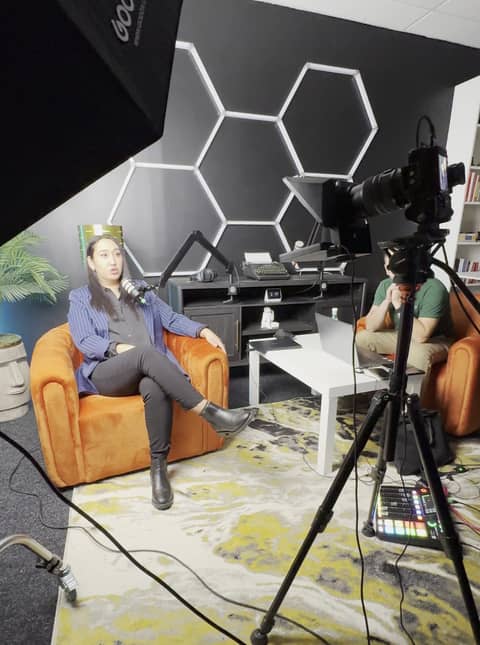
Kreate Vision Studio in Palatine, Illinois records every podcast on three 4K cameras, switched live by the engineer: in the usual two-person setup that is a wide shot that holds the room and a single on each speaker. One camera gives an editor one frame for the whole hour, with no way to cut around a stumble or show a reaction. Three cameras, switched live by an on-site engineer, means a finished multi-camera episode the same day, plus the raw angles to re-cut later.
The cut follows whoever is talking
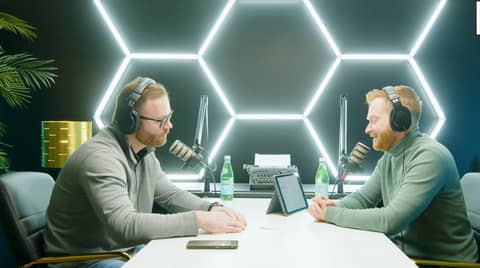
A video podcast is shot on three cameras because a conversation has more than one person worth watching. A wide shot holds the room. A single on each speaker lets the cut follow whoever is actually talking, and cut away to the other person’s reaction when they are not.
One camera cannot do either of those things. It watches one frame for the whole session, and the edit is stuck with whatever that frame happened to catch. Search for a multi-camera podcast setup or a 3-camera video podcast setup and the same idea comes up under both names: more than one lens on the table.
What the three shots are actually for
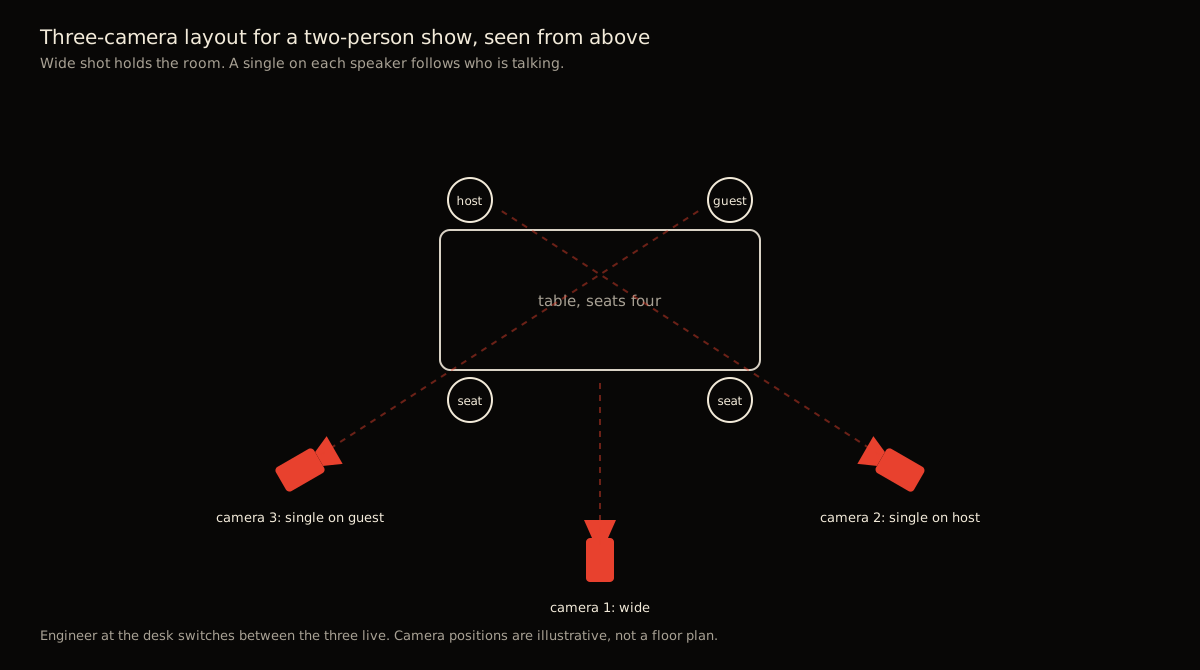
Each of the three cameras does a specific job the others cannot cover on their own.
The wide. Shows the room, the set, and everyone at the table. It is the shot that resets the scene: who is here, what the room looks like, how many people are talking. It is also the shot to cut to when two people talk over each other, because it shows the interaction rather than trying to pick a side.
The single on speaker one. A close, steady shot on the host. Used when they are asking a question, making a point, or carrying a stretch of the conversation on their own.
The single on speaker two. The matching shot on the guest, framed the same way, so cutting between the two singles does not jump in scale or angle.
The two singles sit on the same side of an imaginary line drawn between the two speakers. Film editing calls this the 180-degree rule. Keep every camera on one side of that line. The host then stays on the left of frame and the guest on the right in every shot, so a cut never flips them. Cross it and the audience loses track of who is facing whom (Wikipedia, “180-degree rule”, read 2026-09-04). That is why the layout below is a fan on one side of the table, not a ring around it.
Put together, that is a wide plus two singles for a standard two-person interview, which one industry guide describes as the setup where “when someone speaks, the cut is obvious. Speaker changes are clear, and clips isolate cleanly” (Cutback, 2026). The alternative for two people is two singles and no wide, which edits faster but loses the room entirely. A wide-only setup is the weakest option once there is more than one speaker to track, because a single frame cannot isolate anyone.
What one camera actually costs you
A single camera is not a smaller version of a multi-camera shoot. It removes options an editor cannot get back afterward, because the angle was never recorded.
| What you lose | Why it matters |
|---|---|
| No way to cut around a stumble | A pause, a restart, or a lost word stays visible on screen; there is no second angle to cut to and hide it |
| No reaction shots | The moment someone reacts to what was just said never gets shown, because no camera was pointed at them |
| One static frame for the whole session | The same composition for thirty or sixty minutes, whether one person is talking or four |
| Every vertical clip crops from the same wide | A 16:9 frame cropped to the 9:16 vertical that Shorts and Reels use keeps about a third of the width: 1920 by 1080 becomes 608 by 1080. From a wide shot that third is a slice of table, not a face |
| No coverage when a guest speaks off to the side | A single fixed camera has one field of view; anyone outside it is off-frame until they lean back in |
| No clip-ready close-up for short-form | YouTube describes Shorts as vertical videos up to 3 minutes long; a clip that long from a single wide reads as a distant table for its whole length |
| Nothing to re-cut later | If the edit does not work, there is no second angle in the raw footage to try instead |
Six things a single-camera recording cannot do that a three-camera recording can.
The wide shot in particular is what a fixed single camera is usually standing in for. It is also the shot that resets a scene when the conversation gets unpredictable, which a locked single camera cannot do without losing the speaker.
What the live switch actually delivers
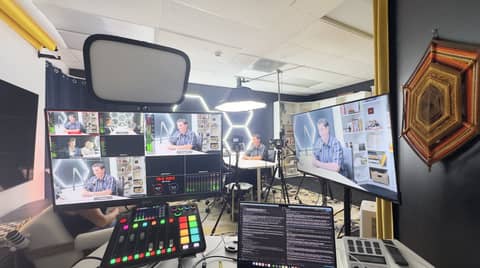
A live switch turns three camera feeds into one finished episode while you are still recording. Three cameras produce three separate video files by default. Somebody still has to decide, shot by shot, which one is on screen at any given second. That decision either happens live, during the recording, or later, in an edit.
A live switch means an engineer is watching all three feeds during the recording and cutting between them in real time. Multiple-camera television calls the result a line cut. The director has the technical director, the vision mixer in UK terms, switch between the camera feeds as the scene plays. That cut is transmitted live or recorded (Wikipedia, “Multiple-camera setup”, read 2026-09-04). A podcast session is the same job at a smaller desk. Leave with that, and the episode is finished: it does not need an editor to assemble the picture, only to trim it if at all.
The raw angles are the alternative path. Instead of a decided cut, you get every camera’s full footage plus the audio, and an editor makes the shot decisions afterward, at whatever pace the project needs. Both exist at once when the studio also hands over the raw files alongside the live-switched cut: the finished episode for today, and the material to build something different from later.
How this changes with how many people are at the table
The three-camera principle does not change with guest count. The assignment of those three cameras does.
| Guest count | Camera assignment | What the cut can do |
|---|---|---|
| Host plus one guest | Wide, single on host, single on guest | Cut cleanly between the two speakers, plus a wide for transitions or crosstalk |
| Host plus two guests | Wide, single on host, single that catches both guests | The two guests share coverage on one angle; the host gets dedicated coverage on the other |
| Roundtable of four | Wide covering the table, the two other cameras covering each side | No single guest gets a dedicated angle; the cut works off the wide and whichever side camera is on the speaker |
Three cameras stay fixed. What changes is which shot each one is assigned to cover as more people join the table.
How many guests fit in the room covers what a full table does to the conversation itself, separate from what it does to the cut.
What to wear and where to look
Two things affect the picture directly. Solid colors read better on camera than fine patterns, and looking at the person you are talking to, not the camera, is what makes the singles look like a real conversation instead of two people addressing a lens. The full prep list, including what to bring and what to leave at home, is in preparing for your first studio session.
What this looks like at Kreate Vision Studio
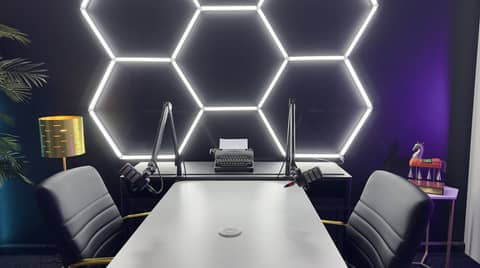
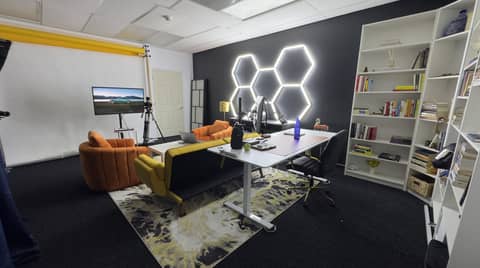
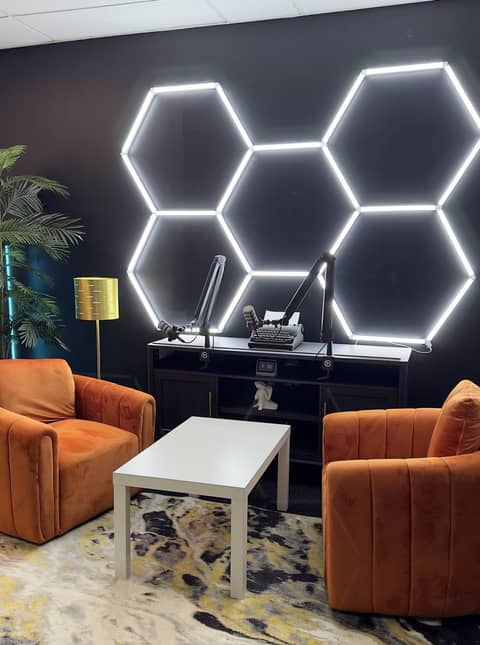
The Hive runs three 4K cameras as the standard setup for every Podcast Recording booking, not an add-on. The table seats four, host plus up to three guests, with five in the room including the engineer. An on-site engineer runs the desk and switches live, so the session leaves the same day as a finished multi-camera cut. The raw video from each camera and separate audio tracks come with it, so the footage is also there to re-cut later if a clip needs a different angle than the live cut chose.
Rate is $250 per hour, 90-minute minimum, $375. Two-hour, three-hour and longer blocks are priced on the pricing page. What the engineer does during your session covers the switching decisions in more detail, and getting clips out of a long conversation covers what the three angles make possible once the episode exists.
Book the room through Square Appointments, or see the cameras and the table yourself with a 15-minute studio tour. Questions before booking: contact us or call (224) 328-2853.
Sources
- Wikipedia, “180-degree rule,” read 2026-09-04
- Wikipedia, “Multiple-camera setup,” read 2026-09-04
- YouTube Help, “Get started creating YouTube Shorts” (Shorts are up to 3 minutes long), read 2026-09-04
- Cutback, “The Complete Video Podcast Blueprint: 1-4 Person Setups, Camera Angles, Lighting Diagrams,” read 2026-09-04
- Kreate Vision Studio rate card, Square Appointments, read 2026-08-24.
How many cameras does a video podcast need?
Three, at minimum, for the standard two-person format: a wide shot of the room and a single on each speaker, so the cut can follow whoever is talking. At Kreate Vision Studio every Hive booking runs three 4K cameras as the standard setup, not an upgrade you add on top of a base rate.
What does one camera cost you compared to three?
One locked frame for the whole session. No cutting around a stumble, no reaction shot when the other person is talking, and every vertical clip cropped from the same wide angle instead of a real close-up on the person speaking.
Do I need more cameras for a roundtable than an interview?
The camera count can stay at three, but the assignment changes. A four-person roundtable at Kreate Vision Studio still runs on three cameras covering the wide and both sides of the table, so no single guest gets their own dedicated angle.
What does a full video podcast camera setup include?
A wide camera on the room, a single on each speaker, and someone switching between them while you talk. At Kreate Vision Studio in Palatine that is three 4K cameras and the on-site engineer running the desk, included in the standard $250 per hour rate rather than added on top of it.
Do I get a finished episode the same day?
Yes, if the engineer switches live. Kreate Vision Studio delivers a live multi-camera cut the same day the session is recorded, plus the raw video from each angle and separate audio tracks, so the same footage is also there to re-cut later if a clip needs a different shot.