
How Many People Fit in a Podcast Studio?
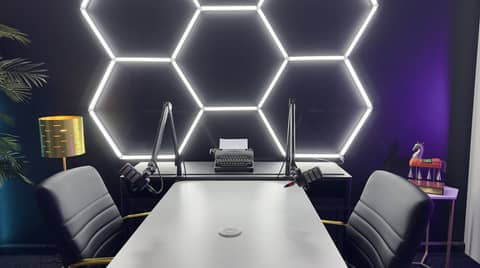
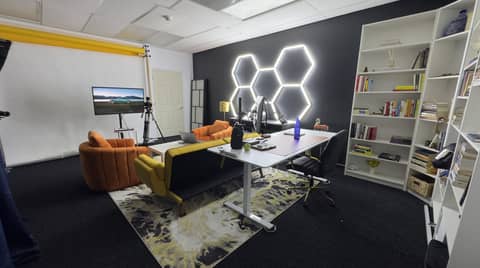
The table at Kreate Vision Studio in Palatine, Illinois seats four, which is a host plus up to three guests, and the room holds five including the engineer. Solo formats are the hardest to sustain and the easiest to schedule. Two-person interviews are the most reliable format and what most shows should start with. Three and four people at the table fill time easily but produce recordings where people talk over each other and the edit gets harder, so they work best with a host who is willing to direct rather than participate.
Each extra person is a trade
More people in the room makes an episode easier to fill and harder to control. That is the whole trade, and it is worth making deliberately rather than by accident because a friend was available.
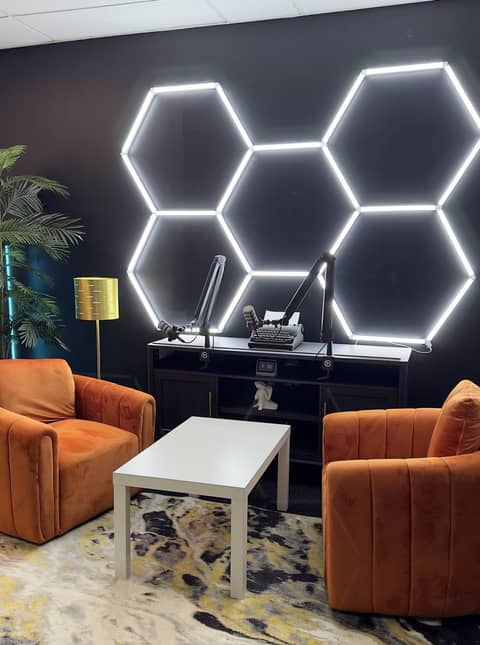
The table seats four, which is a host plus up to three guests. The room holds five, including the engineer.
The formats, honestly
| Format | People | Easiest part | Hardest part |
|---|---|---|---|
| Solo | 1 | Scheduling. Nobody to coordinate with | Sustaining it. Every silence is yours |
| Interview | 2 | Fills time naturally, low prep per episode | Booking a good guest every time |
| Three-hander | 3 | Energy, banter, and it rarely goes flat | Somebody has to be the one who cuts in |
| Roundtable | 4 | Never runs out of material | Crosstalk, and the edit |
Solo is harder than it looks
The format that seems simplest is the one most likely to stop. There is nobody to hand off to, no rhythm that emerges from a second person, and no one to rescue a point that is not landing. Every pause is a decision.
Solo shows work when the host is prolific and has a point of view strong enough that people are tuning in for it specifically. They struggle when the host is figuring out what they think while recording, which is what most first-time solo episodes actually are.
If you want to start solo, script more than you think you need and record two episodes back to back so you can hear the difference between them.
Two people is the reliable default
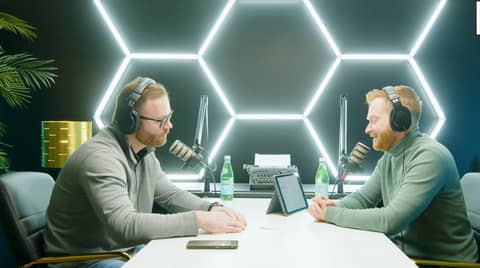
Most of the shows that keep coming back here are two people talking. That is not a coincidence.
An interview needs the least preparation per episode, because the guest brings the content. It fills time without effort, because conversation naturally does. And critically, it is the only format where you can turn up tired and the episode still works, because the other person carries it.
If you are not sure what format to start with, this is the answer, and the second chair is why the room is set up the way it is.
Three and four: the crosstalk problem
Three and four people at a table produce great energy and a harder recording.
What goes wrong is not volume, it is overlap. Four people who are enjoying themselves talk over each other, and the moments that get talked over are disproportionately the good ones, because a good point is exactly what makes somebody else jump in.
Two things make it work, and the room is built for both:
- A host who directs rather than participates. Somebody has to be willing to say “hold that, let him finish” out loud, on the recording. It feels rude in the moment and it is the difference between a usable recording and a wall of noise.
- Separate audio tracks. Every microphone records to its own track here, which means crosstalk is fixable in the edit rather than fatal. On a single mixed track it is neither.
What the cameras are doing
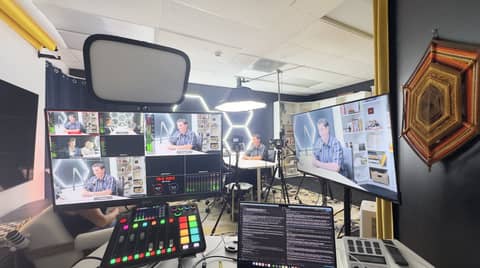
With more than two people, the reaction shot stops being decoration and starts being the edit. When one person makes a point, the useful frame is often somebody else’s face.
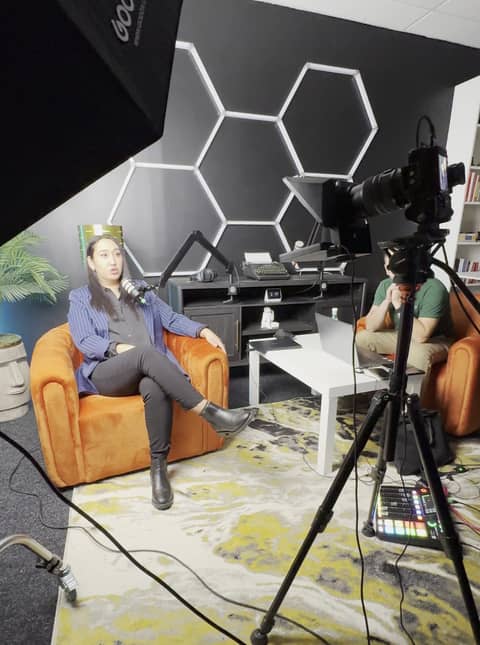
Three cameras cover the wide and both sides of the table, which is what makes a four-person conversation cuttable at all. The room and the gear list covers the rest of the setup. It is also why the angles have to exist at recording time. Nobody can add a reaction shot afterwards.
How the three cameras get assigned as the table fills, and what one camera costs you, is in why a video podcast is shot on three cameras.
Picking a format
How to prepare for your first studio session covers the running order and what to send a guest. Choosing a set covers which of the five rooms suits which format.
Tell us the format
Tell us the format when you book so the table and the microphones are set for it before you arrive. Square Appointments, or (224) 328-2853.
How many people can be in the studio?
The table seats four, a host plus up to three guests, and the room holds five including the engineer.
What is the easiest podcast format to sustain?
A two-person interview. It needs the least preparation per episode, it fills time naturally, and it is the only format where you can have a bad day and the other person carries it.
Are solo episodes harder?
Yes, considerably. There is nobody to hand off to, no natural rhythm, and every silence is yours to fill. Solo shows work when the host is prolific and has a strong point of view, and struggle otherwise.
What goes wrong with four people at the table?
Crosstalk. Four people who are all enjoying themselves talk over each other, and the best moments land on top of somebody else's. It is fixable, but it requires a host who is willing to direct the room rather than just take part.
Does more people mean a harder edit?
Yes. Separate audio tracks per microphone make crosstalk fixable rather than fatal, but there is more of everything to cut, and reaction shots matter more, which is what the three-camera setup is for.