When a Studio Beats Your Own Office, and When It Does Not
A three-camera studio changes two things over recording at your own office: the output, because three angles let a conversation cut instead of sitting on one static frame, and the workload, because an engineer runs the recording rather than someone on your team doing it while also taking part. Your own office is the better choice for disposable or context-dependent video, and for anything meant to look like your actual workplace. Kreate Vision Studio in Palatine, Illinois is $250 per hour with a 90-minute minimum, so $375 for the smallest session, with the multi-camera cut delivered the same day.
The question is not whether a studio looks better
It does, and everybody already knows it. What people in Palatine and the surrounding northwest suburbs are weighing is whether the upgrade justifies the drive, the rate, and the extra step of leaving their own building.
That is a fair question and it deserves a straight answer, including the part where the answer is no.
What an engineer-run room changes
You walk in and record. Nothing is set up by you.
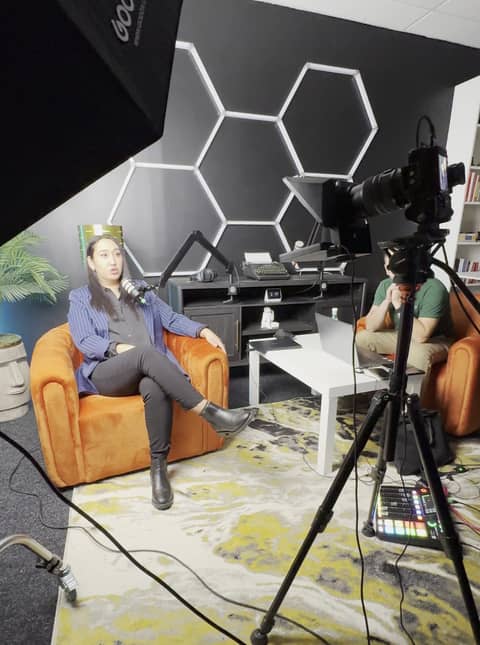
The output changes. Three cameras means a wide shot and two angles on the people talking, so a conversation can cut the way an interview show cuts instead of sitting on one static frame for forty minutes. Every vertical clip anyone pulls from that episode later depends on those angles existing at the time of recording. You cannot add them afterwards.
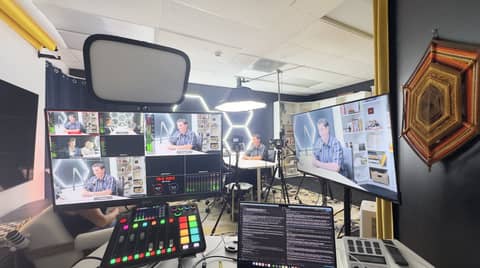
The workload changes, and this is the real trade. In an office setup somebody on your team is the camera operator, the audio person and a participant, often simultaneously. Something always slips: a light that was never switched on, a microphone running too hot, a laptop fan audible in every take, discovered three episodes later. In the studio none of that is your job. The engineer’s whole attention is the recording, which means problems get caught in the moment rather than in the edit.
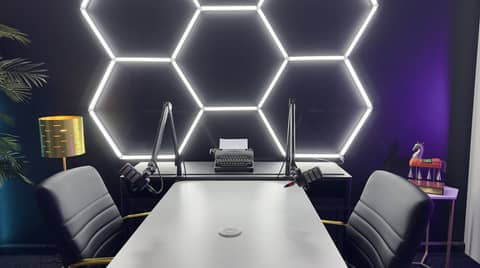
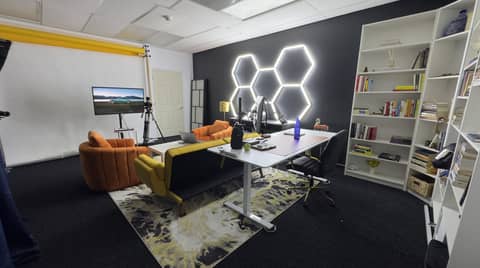
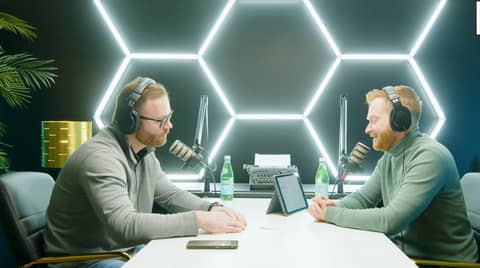
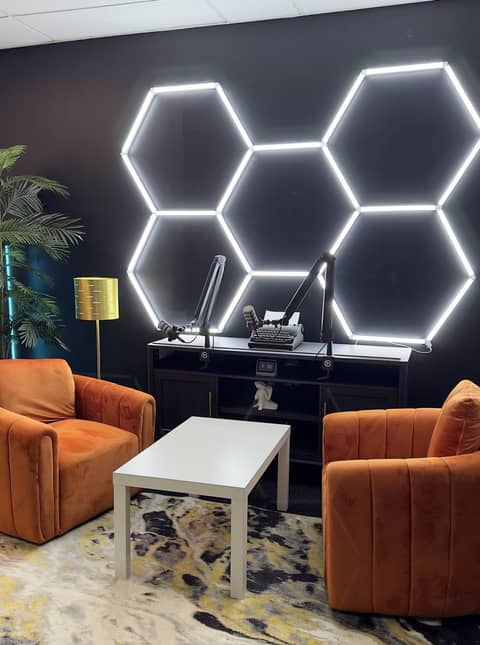
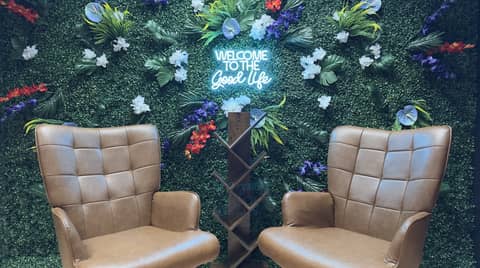
The room can match the format. Five sets means a roundtable does not have to be shot on the same backdrop as a solo interview. There are five to move between, and using more than one in a booking costs nothing extra. Four seats at the table, a host plus up to three guests, and five people in the room including the engineer.
What same-day delivery buys you
Live cutting means the switching between angles happens during the recording, not after it. The engineer is making edit decisions in real time while you talk. That is why delivery is same day rather than same fortnight.
If you publish on any kind of schedule, that turnaround is the difference between a rhythm and a backlog. A show that comes out consistently builds an audience. A show that is permanently three weeks behind because the edit is sitting in someone’s queue quietly stops being recorded.
When your office is honestly the better choice
Not every recording needs a studio, and we would rather say so than sell you a block you did not need.
Your office is fine when the content is disposable or short-lived: an internal update, a quick customer testimonial, a clip for a sales follow-up. Nobody is grading that against broadcast. It works because the message is good.
Your office is actively better when the point is that it looks like your actual workplace. A founder walking the floor. A product demo at the desk where the product lives. A short “here is what shipped this week” for the team. That footage is supposed to look like where the work happens, and putting it on a set works against it.
The line is roughly this. If the recording is context-dependent or disposable, record it where you are. If it is a recurring show, something you intend to put ad budget behind, or anything you are publishing to build an audience over time, the studio changes the arithmetic in your favour on both quality and your own hours.
The two side by side
| Your own office | Kreate Vision Studio | |
|---|---|---|
| Who runs the recording | Someone on your team, usually while also taking part | An on-site engineer, so the host only hosts |
| Camera angles | Whatever you set up, usually one | Three 4K cameras: wide, host, guest |
| Cutaways and vertical clips | Only if you happened to shoot a second angle | Available, because the angles exist at recording time |
| Edit turnaround | Whenever someone gets to it | Live multi-camera cut, same day |
| Room sound | Whatever the room is | Set and levelled before you sit down |
| Seats | However many fit | Four at the table, five in the room |
| Look | One backdrop | Five sets |
| Cost | Gear, storage, and your team’s hours | $250/hr, 90-minute minimum, so $375 to start |
| Best for | Disposable, internal, or anything meant to look like your workplace | Recurring shows, ad-ready video, anything building an audience |
The specifics
The podcast room is three 4K cameras with an on-site engineer on every session, five sets to choose from, four at the table and five in the room, live-cut during the recording with same-day delivery, plus every raw file and separate audio tracks.
The rate is $250 per hour with a 90-minute minimum, so $375 for the smallest bookable session. Longer blocks come down: six hours is $1,400 and eight hours is $1,800. Full rates are on the pricing page.
The studio is at 800 E Northwest Hwy Ste 90 in Palatine, open daily from 9am to 8pm. Booking around a real working schedule is not the obstacle it usually is with shared studio space.
Where to go next
If you are still costing this out, what it actually costs to record a podcast has the full block table. If you have not recorded anything yet, what you actually need to start a video podcast is the earlier question.
If the other person is not in the same city at all, the question changes shape: see remote recording or the studio.
Booking
Booking runs through Square Appointments online. If you would rather talk the format through first, call (224) 328-2853. Five sets and a handful of episode structures usually make more sense in a five-minute conversation than on a page.
If you are unsure which side of the line your next recording falls on, that is a reason to call rather than a reason to wait.
What does a three-camera studio add over recording in an office?
An engineer running cameras and audio so the host only hosts, a wide shot plus two angles so a conversation can cut instead of sitting on one static frame, and a room set for the format rather than a desk that happens to be free.
How fast is the finished video after a session?
Same day. The engineer switches between the three angles during the recording itself, so the multi-camera cut is essentially finished by the time you stand up. You also leave with every raw file and separate audio tracks.
Is it ever fine to just record at our own office?
Yes, and often. A single-camera talking head for an internal update, a customer testimonial, or a clip that is supposed to look like your actual workplace is fine on office gear. Bringing that into a studio can work against it.
What does a session cost and how do we book?
The podcast room is $250 per hour with a 90-minute minimum, so $375 for the smallest session. The studio is at 800 E Northwest Hwy Ste 90 in Palatine, open daily 9am to 8pm. Book through Square Appointments online or call (224) 328-2853.